In Tasks 51 and 52 of the TOPIK II PBT Writing section, you must restore one sentence in each of two gaps. Your answer must preserve the meaning of the text, fit the context before and after the gap, be grammatically complete, and match the register.
Each task is worth 10 points. Numbers 51–52 belong to PBT: TOPIK II IBT Writing has a different, three-task structure.
1. How Task 51 differs from Task 52
Shared format of Tasks 51–52
- Format
- TOPIK II PBT
- Gaps
- 2 in each task
- Answer
- 1 sentence
- Maximum
- 10 points
The format is shared, but the work with the text differs. In No. 51, you restore the writer's action within a functional text. In No. 52, you restore a missing link in an explanatory argument.
| What to check | Task 51 | Task 52 |
|---|---|---|
| Text type | A message, letter, notice, or public question | A short explanatory text |
| What to restore | The writer's request, question, plan, reason, experience, or wish | A cause, consequence, contrast, limitation, recommendation, or name for a mechanism |
| Main clues | Writer, addressee, purpose, time, punctuation, and degree of politeness | Claim, connectors, causal chain, references, verb government, and negation |
| Main risk | The grammar fits, but the phrase does not perform the required speech act | The sentence is correct on its own, but breaks the development of the idea |
In the reviewed sample of nine Task 51 items, there are bulletin-board posts, formal and personal letters, messages, invitations, and requests. In twelve saved Task 52 items, the texts are built around comparison, contrast, cause and effect, recommendation, an explanation of a mechanism, or classification. This is an observation from a local corpus, not an official classification of all exam tasks.
2. Check the left join, the function, and the right join
Before formulating the Korean, name the missing meaning in plain language: for example, ‘state a past experience’ or ‘call the described chain a method of protection.’ Then choose the form and reread the whole text. This is a TopikLab self-check method, not an official answer template.
- 01
Left join
Mark the subject, object, verb government, time, and negation. Decide what form the unfinished construction requires.
- 02
Function
Name the job of the gap: a request, experience, cause, result, definition, or another specific relationship.
- 03
Right join
Find the consequence, explanation, repeated referent, or writer's reaction that must continue your answer.
- 04
Register
Match the ending to the genre: a personal message, a formal request, or a neutral explanation.
3. Task 51: restore the writer's action
In No. 51, first establish the communicative situation: what genre is this, who is writing to whom, what is already known, what action must the gap perform, and what degree of politeness does the text set?
Solution map: genre → addressee → speech act → required meaning → grammatical frame → register.
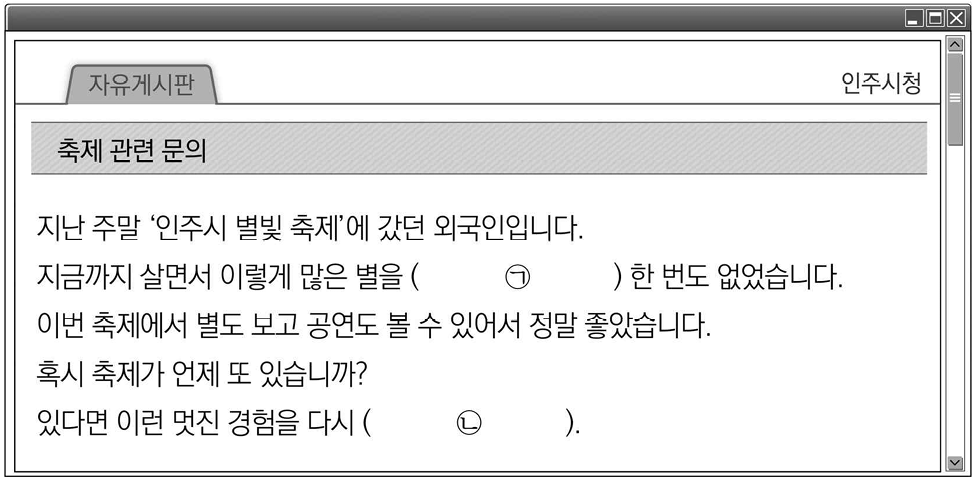
지금까지 살면서 이렇게 많은 별을 ( ㉠ ) 한 번도 없었습니다.
있다면 이런 멋진 경험을 다시 ( ㉡ ).
㉠
A past-experience construction
지금까지 살면서 sets a life-experience frame, 한 번도 없었습니다 means ‘there has not been even once,’ and the object 별을 requires the action ‘see.’
The complete sentence says that the writer had never seen so many stars before. A simple past-tense form would not complete the experience construction.
㉡
A wish to repeat the experience already mentioned
The question about the next festival has already been asked. 있다면 creates the condition ‘if it takes place,’ 다시 means repetition, and 이런 멋진 경험 refers back to the stars and performance.
An answer that asked for the date again would repeat the preceding line. What is needed here is the writer's reaction: a wish to have this experience again.
Try applying the same method to a new functional message. This is an original TopikLab exercise, not a task from a past session. Fill both gaps independently first, then open the model answers below.
도서관 이용 안내
도서관 공사로 인해 이번 주 토요일에는 열람실을 사용할 수 없습니다. 책을 반납해야 하는 분은 ( ㄱ ).
도서관 입구의 무인 반납함은 공사 중에도 이용할 수 있습니다. 다음 주 월요일부터는 공사가 끝나서 ( ㄴ ).
ㄱ · model answer
A request to use the available return method
The next sentence immediately confirms that the return box at the entrance works during the renovation. The ending suits a written notice.
The option 책을 집에서 읽으시기 바랍니다 is grammatically possible and polite, but it does not solve the return task or connect to the following sentence about the box.
ㄴ · model answer
The specific service resumes after the renovation
다음 주 월요일부터 sets the point of change, and 다시 returns the reader to the reading room that was temporarily closed.
The option 새로운 책을 많이 빌릴 것입니다 adds an action not given in the text and does not explain what will change after the renovation ends.
4. Task 52: restore the logic of an explanation
In No. 52, identify the claim and the relationship between the sentences: parallel, contrast, cause, consequence, recommendation, limitation, or classification. Then check what reference words such as 이것 point to and who performs the action.
식물은 다양한 방법으로 자신을 보호한다. 덩굴성 야자나무는 빈 줄기를 개미에게 집으로 제공한다. 이 나무에 다른 동물이 다가오면 줄기 속에 있던 개미들은 밖으로 나온다.
이때 개미들의 움직임으로 소리가 생긴다. 이 소리는 동물을 깜짝 ( ㄱ ). 결국 놀란 동물은 나뭇잎을 먹지 못하고 달아나 버린다.
식물학자들은 이것이 바로 이 나무가 자신을 보호하는 ( ㄴ ).
- The palm provides ants with a hollow stem
- When an animal approaches, the ants come out
- Their movement creates a sound
- The sound frightens the animal
- The animal runs away without eating the leaves
- The chain is called the tree's method of protection
ㄱ
The cause of the state in the next sentence
Before the gap, the sound affects the animal. The causative 놀라게 한다 expresses the required relationship: ‘makes it frightened.’
The right join confirms the form: the next line has 놀란 동물, an animal that is already frightened and then runs away.
ㄴ
The name of the whole mechanism
이 나무가 자신을 보호하는 requires a noun meaning ‘method.’ 방법이라고 한다 completes the botanists’ statement.
The reference word 이것 refers to the whole causal chain, not only to the nearest sound or the animal’s flight.
Now practise the logic of an explanatory text separately. This is an original TopikLab exercise; the answers below are natural model answers, not the only official key.
사람들은 새로운 단어를 많이 외우면 외국어 실력이 빨리 늘 것이라고 생각한다.
하지만 단어의 뜻만 외우면 실제 상황에서 ( ㄱ ). 단어가 어떤 문장에 쓰이는지 함께 살펴봐야 한다.
또한 며칠 뒤에 그 단어로 새로운 문장을 만들어 보면 ( ㄴ ).
ㄱ · model answer
The problem solved by the following recommendation
하지만 creates a contrast: knowing a meaning alone does not ensure appropriate use. The next sentence recommends looking at the sentences in which the word is used.
The option 외국어 공부가 어렵다 is thematically close but too general: it does not explain why you should examine the use of a particular word.
ㄴ · model answer
The result of a delayed self-check
Making a new sentence a few days later becomes a way to check whether the word has been learned.
The option 그 단어를 절대 잊지 않게 된다 sounds fluent, but turns a check into an unsupported absolute guarantee.
If you want to see whether this method transfers to an unfamiliar text, complete a new Task 51–52 exercise in TopikLab and then compare your answer with the explanation of the context and grammar.
5. How an answer is assessed, and why matching a key alone is not enough
The general instruction requires one sentence in each gap. In examples in the official guide, each suitable gap is worth 5 points, so a task can receive 10 points.
The guide draws attention to fit with the context, suitable vocabulary and grammar, spelling, register, and the absence of extra information that changes the original meaning. It does not publish a universal catalogue of all acceptable wordings for every text.
Do not copy words around the brackets. One gap needs one complete answer, not a list of options or a continuation over several sentences.
6. A map of common errors
| Error | In Task 51 | In Task 52 | What to fix |
|---|---|---|---|
| The answer fits only on the left | It ignores the reaction or request in the next line | It does not create the state or conclusion that appears next | Read the right join separately |
| A new fact is added | The writer suddenly reports an event not mentioned | The explanation gains a missing cause | Reduce it to the required meaning |
| A participant is lost | The request is addressed to the wrong person | Cause and effect are assigned the wrong subjects | Mark the writer, object, and agent |
| The relationship is broken | An experience becomes a plan; a request becomes a statement | A cause becomes an effect; a contrast becomes confirmation | Name the function before choosing grammar |
| A register shift | A personal ending appears in a formal request | A colloquial form appears in a neutral explanation | Restate the meaning in the register of the source text |
7. Self-check before writing your answer
- 01
Name the function
State the missing meaning in one short phrase without Korean grammar.
- 02
Find two anchors
Underline the form on the left and the word, state, or relationship that confirms the answer on the right.
- 03
Read the whole fragment
Insert the full sentence and check the development of the idea from beginning to end.
- 04
Remove what is unsupported
Remove any detail that cannot be traced back to the source text.
- 05
Check the form
Check spelling, particles, endings, and a consistent register.
8. Frequently asked questions
Is there one correct answer?
The wording may differ if it retains a mandatory meaning, is suitable for both parties and corresponds to the language norm.
Do you need complex grammar?
No. We need a construct that accurately expresses the function and is case compatible.
Is it possible to add a clarification?
Add only content that is necessary for the context. An extra detail can distort the original meaning.
Are these tasks available in TOPIK II IBT?
Numbering 51–52 and the form described refer to TOPIK II PBT. IBT has a separate structure.